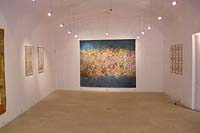
Woven Music: Concerto Grosso tapestry Galeria Tapeçarias Portalegre, 2002
332
x 500 pixels, 22 Kb
498
x 750 pixels, 36 Kb


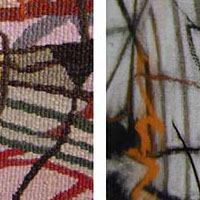
Details: Concerto Grosso tapestry
and Concerto Grosso
371
x 500 pixels, 54 Kb
557
x 750 pixels, 97 Kb


| Title |
|
| Introductory Notes | << |
| Gallery | |
| As You Enter | |
| To Your Left | |
| To Your Right | |
| As You Go | |
| Additional Material | |
| A Check List | |
| The Fascination of Wool | |
| The Art of Tapestry |

The Manufactura Tapeçarias Portalegre was bought into being in the 1930’s by Guy Fino whose aim was to produce the finest quality tapestries from original designs by artists.
At this time the leading tapestry manufacturer was in France and Fino had to secure his position by seeking permission to make a version of an existing French tapestry and challenging the artist to a blind selection. The Portalegre tapestry was the clear winner and the fledgling company was able to establish itself. The particular quality of the Portalegre tapestry is partly due to the invention of a unique stitch. The stitch enables the weavers to interpret every subtlety and nuance of the original design.
In 1981 Guy Fino approached Tom Phillips to make a tapestry of his pastel drawing Family Music (collection Channel 4 Television). Phillips had already made tapestries with the Ovahimba in Namibia and also Edinburgh Tapestry Company at Dovecot Studios, each of which had particular qualities. He discovered a different process when he worked on the design for the Tapeçarias of Portalegre.
“I made a large cartoon on paper textured like the grain of fabric, using pastel which already has some of the light-absorbing quality of dyed and woven wool. Plotted and transferred to the loom this was laboured on with such rigourous exactness by the amazing ladies of Portalegre that in the final product I can see not only the holes made by the drawing pins which had attached the drawing to my studio wall but even the faint ring of rust that had gathered round them.”
Manufactura Tapeçarias Portalegre is now run by Fino’s daughter, Vera sá da Costa and in the intervening years four more tapestries have been made. The most recent of these, Concerto Grosso, was one of their most challenging pieces. Lurdes Serra made the enlargement and matched the colours, her name is woven onto the lower edging close to the identification number on the reverse side. It took her 80 working days to prepare the drawing for weaving. Two others worked at the warehouse separating the wool colours and this took a month. Four women did the weaving and preparation of the “mescals”, these are the mix of different colours in the same weaving thread (8 wool threads to one weaving thread). The weaving took 626 working days.
The finished work was shown alongside the other tapestries and related paintings, drawings and collage works at the Galeria Tapeçarias Portalegre in Lisbon between December 2002 and February 2003.
Here follows a virtual tour of the exhibition. > >
Exhibition notes, Lisbon 2002



tomphillips.co.uk > > Essays and Exhibitions