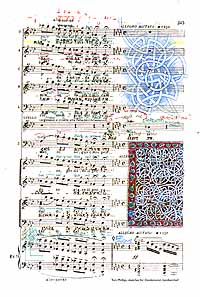
Sketches for Desdemona's Handkerchief
Mixed media on musical score, 1998
743 x 500 pixels, 123 Kb
1115 x 750 pixels, 234 Kb


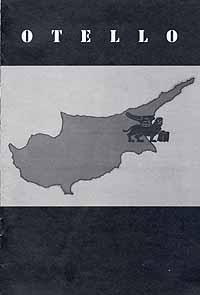
'Otello' programme half-title
Designed by Tom Phillips
737 x 500 pixels, 39 Kb
1105 x 750 pixels, 92 Kb


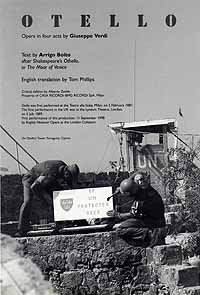
'Otello' programme title page, 1998
736 x 500 pixels, 83 Kb
1105 x 750 pixels, 163 Kb



Indeed the final set skeletally echoes the structure of the 400-year-old castle in its prowlike orientation towards the sea (from which danger might come at any time) and the intimated presence of as much activity below ground as above, since one of the excitements of visiting the castle had been to walk the massive underground tunnels and chambers. For all its apparent modernity the set is, in terms of its architectural plan, its displacement of functional elements and the practicality of its construction, more traditional than the conventional fantasy, even down to costumes and props which are largely acquired from catalogues of the clothes and hardware of our own prosaic world. Its links with a longer history are provided by the recurrent motif of the Lion of St Mark, the heraldic device of Venice both then and now. This appears above the barrack gate and is stencilled onto equipment and containers and even (probably) could be found on a corner of Desdemona's bedspread, for she (as an unexpected odd-person-out) is also dependent on the quartermaster's store. Only the notorious and fateful handkerchief is, in the usual sense, designed: but then it is the fifth most important character in the drama.
On the other hand all this naturalism is itself a charade for a set exists only to be lit and has its roots finally in metaphor. Everything you see can be seen through, and though there are many points where characters can, by theatrical convention, conceal themselves there are no hiding places. A private drama occurs in a situation which affords no privacy. The capacity of lighting to alter, shape and focus the stage world is all important and the set aims to be a text for the lighting designer to interpret. In these days of single sets such mutability is more than ever what shifts our scenes.
The motif of surveillance (indicated in this production by the continuous presence of radar and communications equipment) comes both from the necessities of military readiness and the nature of the drama in which so much is about spying, overhearing, receiving the reports of others, etc. Boito's economical climax of this process comes in the very first words of the final act when Desdemona, herself now ultimately sucked in to a world of spying, is questioned by Emilia as to whether Otello's mood has changed ('Was he calmer?'). Iago's literal watchword ('Vigilate!' in the original) has reached her too.
The business of translation for an opera house is hair-raisingly unlike the activity of painting. Instead of seeing the marks made yesterday with all their alterable faults and retainable virtues there on the easel in the morning, it is as if one found revisions in another hand, one's own marks erased, when re-entering the studio. One gets used to this process eventually as the company's protagonists make their various contributions and singers introduce their preferred vowels. Yet in the end, as with drawing, the strong marks survive (sometimes by making a late comeback) and the weak ones wither away. Most difficult to expunge is the dead language that opera favours. Phrases like 'in mortal anguish' have long since dropped from the living tree of expression and, for all their apparent gravity, are emotionally weightless. But singers tend to hug them like old friends. Some of the best lines here, however, come not from the translator but from the singers themselves who, once in the emotional flow of the action, spontaneously simplify or set light to page-bound words.
At the time of writing we have just entered full rehearsal (the psychodrama of the opera house itself) and I am designing the handkerchief and making final revisions to the libretto. It you should question why the translator is choosing colours for a handkerchief, or why the designer is fiddling with words, the answer is, as I now see it, that both activities are, with regard to their respective idioms, kind of translation.
What is vital is that they both serve the magnificently lyric drama that Boito and Verdi conceived. Of all arts, opera is the most realistic in that it depicts in outward form our real extravagant inner lives. Our emotions are not amplified on the stage: rather it is that in our daily lives they are muted and constrained.


tomphillips.co.uk > > Essays and Exhibitions