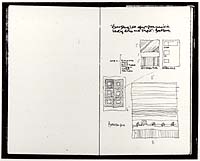
Journal Entry for Benches (1), 1970
201 x 250 pixels, 14 Kb
361 x 450 pixels, 29 Kb
602 x 750 pixels, 54 Kb
, 1970 &imgpath1=painting/bnch&subdirtext1=Paintings and Drawings&subdircode1=painting&picture1=bnch2250.jpg)
, 1970 &imgpath1=painting/bnch&subdirtext1=Paintings and Drawings&subdircode1=painting&picture1=bnch2450.jpg)
, 1970 &imgpath1=painting/bnch&subdirtext1=Paintings and Drawings&subdircode1=painting&picture1=bnch2750.jpg)
`
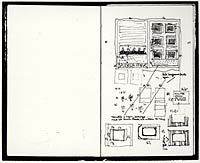
Journal Entry for Benches (2), 1970
204 x 250 pixels, 17 Kb
367 x 450 pixels, 36 Kb
612 x 750 pixels, 69 Kb
, 1970 &imgpath1=painting/bnch&subdirtext1=Paintings and Drawings&subdircode1=painting&picture1=bnch3250.jpg)
, 1970 &imgpath1=painting/bnch&subdirtext1=Paintings and Drawings&subdircode1=painting&picture1=bnch3450.jpg)
, 1970 &imgpath1=painting/bnch&subdirtext1=Paintings and Drawings&subdircode1=painting&picture1=bnch3750.jpg)

Much later it occurred to me why the association of benches with mortality was strong in my mind: my brother had told me (when I was about twelve) that the bench in front of Ashton's the S.E. London undertakers had been put there in order that old people might sit down to rest on it, and dying there, provide trade. It was also on a park bench on Clapham Common that I spent much of the perplexing day on which my father died.
Although the only quotation in the picture comes from the same text as on of the series Ein Deutsches Requiem, there was also a predictive association with Dante: in a page from a notebook which contains the preliminary studies, I tell myself airily to 'read Longfellow's Dante again' (I think I had only just finished it.). Not only was I intending to use at some point the line 'I had not known death had undone so many' but a Dantesque schema underpinned the work as a whole, as I described in the original notes: -
It seemed to me that a picture might deal with the ten pre-purgatorial circles and I got near to planning such a picture, with material from postcards, describing the progressive abandonment of hope. One such circle is exemplified by Benches (Dante often differentiates the stages of his afterworld by the physical positions of the people in them), i.e., the stage of resignation to the fact of death. Within this metaphor there is also a progress; the man that enters the uncharmed circle in Harrogate (who so resembles, in suit and attitude, William Burroughs), the youth who is able, by virtue of youth, to pass unheeding by in Bournemouth, the grim inmates of the enclosed circle at their open gate, the figure emblematically sweeping up in the Bournemouth autumn, the figures turned to black and white in a coloured world as a penultimate metamorphosis on the way to oblivion, and the insubstantial reflection of the yet unthreatened mother with a child in a pushchair who is seen to escape from the picture in the final image while the bench itself is enveloped in flame-like flowers. >>



tomphillips.co.uk > > Paintings and Drawings