![Works/Texts to 1974 [front cover]](images/fla19200.jpg)
Works/Texts to 1974
[front cover]
Treatment of postcard ELHA HE10
&headingname1=Pictures%20from%20Postcards:%20Flags&year1=1974&headdir1=flags&picture1=fla19500.jpg)
Works/Texts to 1974
[back cover]
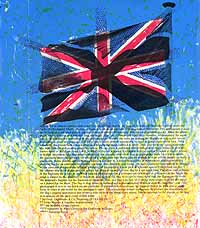
Treated photograph of reconstructed Union Jack from ELHA HE10
&headingname1=Pictures%20from%20Postcards:%20Flags&year1=1974&headdir1=flags&picture1=fla20500.jpg)
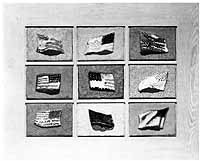
9 Conjectured Flags
Acrylic on plaster reliefs, 37 x 48 cm, 1974


After a lot of what is called history a wall is built through Berlin. An opening in that wall becomes famous under the name of Checkpoint Charlie. Someone is asked to or decides to take a photograph of this motif. This photograph is used as the basis of a coloured picture postcard* which is printed by means of four-colour photolithography. Since the photograph has been taken on a windless day, the bright flag flags fail to flutter and hang limp: however, while making the separations for printing the retouchers at the printing works revivify the scene by making the flags fly as if in a stiff breeze. According to their best memory they fill in the heraldic devices appropriate to Stars & Stripes and Union Jack. They remember the Union Jack as a red cross on a blue background outlined in white. Here and there the casual hand runs the blue over the red creating purple incidents. The postcard is published and distributed to shops, replacing perhaps earlier views of the scene; later it will be itself in its turn replaced. An English artist is invited to teach at the art school in Kassel. He strikes up a friendship with two of the students** who invite him to accompany them on a trip to Berlin. He purchases there the postcard (of which on a subsequent visit to the city six months later he will be unable to find a duplicate). Some months after returning home to London he is asked by a gallery in Nottingham*** whether he would design a flag for an exhibition of flags to celebrate their thirtieth anniversary. He agrees. Almost immediately he thinks of the postcard and proceeds to make a drawing of its eccentric Union Jack as it would appear if stretched out flat. He submits this as his design and the gallery has it made up as a full-size flag by a specialist firm. The show over, it hangs in the bedroom for a year or so. While making preparations for a retrospective exhibition at a museum in the Hague**** the artist is visited by the organiser of the show, who notices the flag. It occurs to them both that the flag might fly from the museum's flagpole for the duration of the exhibition, and that a picture of it flying there might serve for the image on a poster for the show. The flag is thus taken to Holland and is photographed in action atop the museum's pole. The photograph is sent to the artist via the publisher***** of the exhibition catalogue. He suggests that it be used also in some form or other as the motif for the catalogue's cover. The artist make colour separations to recreate the atmosphere of the flag's original appearance and writes a note on how the image came about. This he appends to the picture as it appears on the back cover of this book. > >
* by Ferd. Lagerbauer & Co., Hamburg (ELHA HE10).
** Erika Mignon & Gunther Sichelschmidt.
*** the Midland Group Gallery.
**** organised by Hans Locher at the Gemeente Museum.
***** Hansjörg Mayer.
Works/Texts to 1974, [back cover]


tomphillips.co.uk > > Paintings and Drawings