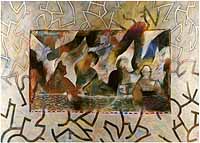
Speaking in Tongues
Charcoal, conté, pastel, 155 x 215 cm, 1980
357 x 500 pixels, 47 Kb
535 x 750 pixels, 85 Kb
678 x 950 pixels, 122 Kb
&year1=1980&headdir1=lgdr1992&picture1=lgd05500.jpg)
&year1=1980&headdir1=lgdr1992&picture1=lgd05750.jpg)
&year1=1980&headdir1=lgdr1992&picture1=lgd05950.jpg)
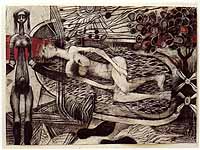
Brahms at Bathtime
Conté, 75 x 100 cm, 1990
375 x 500 pixels, 64 Kb
563 x 750 pixels, 101 Kb
713 x 950 pixels, 137 Kb
&year1=1990&headdir1=lgdr1992&picture1=lgd02500.jpg)
&year1=1990&headdir1=lgdr1992&picture1=lgd02750.jpg)
&year1=1990&headdir1=lgdr1992&picture1=lgd02950.jpg)
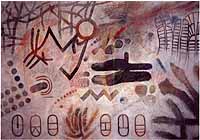
Mythology
Charcoal, conté, pastel, 170 x 260 cm, 1976
349 x 500 pixels, 43 Kb
523 x 750 pixels, 83 Kb
663 x 950 pixels, 125 Kb
&year1=1976&headdir1=lgdr1992&picture1=lgd03500.jpg)
&year1=1976&headdir1=lgdr1992&picture1=lgd03750.jpg)
&year1=1976&headdir1=lgdr1992&picture1=lgd03950.jpg)

In the first few weeks after leaving art school I started a group of sizable charcoal drawings in order to establish myself in my new studio (in Shenley Road) and to feel my way towards an uncertain future. Thus for the last thirty or so years, whenever I have been stuck or have dithered or floundered or come to an impasse in a particular work I have renewed myself by improvising on (increasingly) large sheets of paper.
The robust business of making marks with earth and burnt wood on rough surfaces composed of rags and trees must be as near the primal act of art as one can get. The most important tool (as Schönberg used to tell his pupils) in the creative armoury is the eraser*. Somehow, with rubber and chalk, I seem to have more courage to change and obliterate, destroy and rework than I have with a brush. Frequently I rub the whole this gown with a cloth and start again.
In the seventies (notably with the Months of the Year) I started to use brighter colour, but the predominance of black and rich earth and oxides continues, leaving the erased pigments as a field inhabited by what looks at first glance like a monochrome picture.
These improvisations tend themselves to become groups or series as one leads to another. These clusters can sometimes relate to music or to language or (as after a recent visit to Bayreuth) to the operas of Wagner. Most recently the sequence of drawings that culminates in Rima's Wall came out of a frustration in the summer of 1990 with a portrait I was making of Charles Levison which was becoming crabbier and more cautious by the session. I reached for the nearest substantial piece of paper (the back of a large print) and mead the drawing Brahms at Bathtime based on an anecdote from Lucy Shortis. Within weeks the walls of the studio were covered in huge sheets of paper: I was off again.
*I once asked in a New York art-store whether they had a good selection of rubbers. A withering glance from the young female assistant accompanied the brusque information that condoms were not, at least in the technical sense, an artist's requisite. I have since, at least in print and in public, learned to use the word 'eraser'.
Work and Texts (1992), pp. 85-92.
See also: Large Drawings (to 1997)


tomphillips.co.uk > > Paintings and Drawings