| |
|
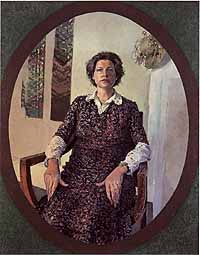
Shirley Cargill 510 x 400 pixels, 43 Kb
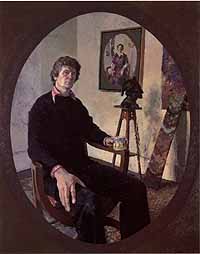
David Cargill 507 x 400 pixels, 27 Kb
|
I started the portrait of Shirley Cargill in 1976 and finished it after twenty-seven fortnightly sittings almost exactly a year later. This work marked my return to formal portrait painting after a period where it had been only an occasional activity with some eccentric examples (viz. the portrait of Angela Flowers). I bought the chair Shirley is sitting in specially for the work since a portrait painter must after all have a proper sitter's chair. Somewhat battered now it is still serving the same purpose, most recently in the portrait of Jeremy King. Portrait painters seem to have a fairly small vocabulary of chairs though gone are the days when a painter like Ingres would send work out to a specialist assistant who would paint the chairs and furnishing in his portraits. The only 'prop' is Shirley's gardening hat hung with dried grasses and flowers which alone serves to show that the sitter is a person more of the countryside than the town. On the wall behind are the Terminal Grey paintings that are currently in production to indicate the Cargills' interest in, and patronage, of contemporary art. The oval composition is traditional where one hasn't a clue what to do with the corners, especially where (as in this case) the lines of the floor do not meet up and every vertical in the room is sloping in a different direction. David Cargill started sitting directly after I had finished painting his wife, almost while the chair was still warm. I asked if I could retain the portrait of Shirley for the background of his portrait: it therefore hangs on the wall which it itself depicts. A bronze bust of Dante rests on a stand before it (David Cargill was one of the original backers of the Talfourd Press Inferno). Two Terminal Grey panels, one contemporary with Shirley's portrait and one in progress, are also visible: the same chair provides a strong link between the two portraits. The size of David's nearer hand seems to be greatly exaggerated, though it would be more accurate to say that it hasn't been subject to the modification of apparent sizes in the artifice of classical perspective. David's right arm in real life' is in any case slightly larger than his left so I though to make it look even more consciously contrasted might be a good solution. The Portrait Works (1989), p. 22-23.
|
|
tomphillips.co.uk > > Portraits
| |