| |
|
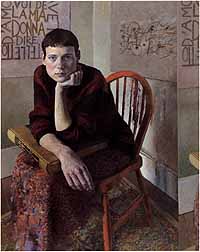
The Dante Binding 505 x 400 pixels, 33 Kb
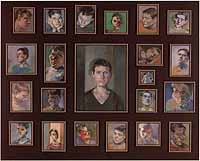
Pella Ersking-Tulloch: Polyptych 323 x 400 pixels, 26 Kb
|
The title of the picture The Dante Binding refers to the book on which the sitter rests her arms. It was the last thing in the picture to be painted since it did not exist until the final three or four sittings. During the months this portrait took to paint, Pella Erskine-Tulloch and I were involved in designing the three volume binding for the Talfourd Press edition of Dante's Inferno. This sample blank volume was the final prototype. It was a triumphant moment in which the silkscreen cloth and spine-titling I had designed came together in her superbly structured binding: the mere presence of the book (replacing substitute books in earlier sittings) was enough to resolve the picture and propel it towards completion. Dante appears elsewhere in the portrait in the inscription on the drawing attached to the wall, which was made especially for the background. The text is the opening of the best known of Dante's Canzone 'Donne ch'avete intelletto d'amore...' which could be rendered in English as With you, oh ladies learnéd in love's waysThus the portrait celebrates a special level of collaboration. The painter is present in the work also (by implication) in the appearance (at the right hand side of the picture) of the edge of the canvas that he is working on: it impinges on his view but ceases to do so if it is deemed part of his view. On the other wall is a work in progress from a series of large drawings about music. The distortions of the picture have their confluence in the back of the chair which as a result became impossible to resolve. The Portrait Works (1989), p. 28-33, 86.
|
|
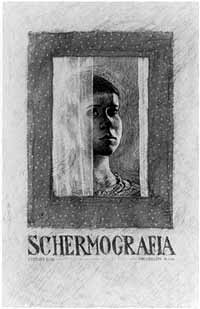
Schermographia 617 x 400 pixels, 32 Kb
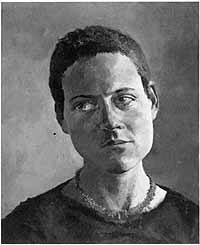
Pella Erskine-Tulloch 491 x 400 pixels, 24 Kb |
The drawing Schermographia was exhibited at the Marlborough Gallery in 1981 in a different form with lines from Dante inscribed beneath it... poi chi pinge figuraThe drawing was drastically reworked in 1986 but retains a Dante connection in its title (the Italian for X-ray) which seems to allude to the "Screen Lady" of La Vita Nuova, references so very dark and personal that I can in retrospect scarcely unravel them myself. The Portrait Works (1989), p. 86. See also: Pella on Saturdays
|
|
tomphillips.co.uk > > Portraits
| |