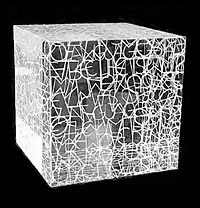
Wittgenstein's Dilemma, Inverted
Silkscreen on acrylic
12.7 x 12.7 x 12.7 cm, 1999
View and rotate in 3D:
400 x 264 pixels, 544 Kb
(see below for download and playing info)
Requires APPLE QUICKTIME
Plugin

Rotation: Wittgenstein's Dilemma, Inverted
Silkscreen on acrylic
12.7 x 12.7 x 12.7 cm, 1999

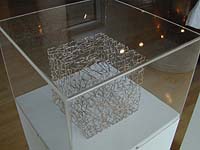
Wittgenstein's Trap
Pure silver cube
15.2 x 15.2 x 15.2 cm, 1999

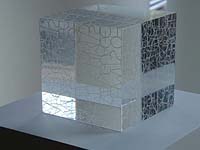
Wittgenstein's Dilemma, Inverted
Silkscreen on acrylic
12.7 x 12.7 x 12.7 cm, 1999


The series of cubes began with a cage of wire made for The Globe Theatre's production of The Winter's Tale. A cage of wire words followed to exemplify Wittgenstein's proposition 'The Limits of My Language are the Limits of My World'.
Printing this on an acrylic cube where the inside can be seen and, by an oddity of optics, experienced from the outside seemed to unite the reading of a statement with its perception as a metaphor. Reversing the text on the outside in a later version emphasised the trap of language that Wittgenstein describes.
TP's notes from his exhibition at Charleston House, 2003
Both cubes find their structure in words. The calligraphy, fissures of curve and isoscelean angles that grew from the wire sculptures of 1997, spell out Wittgenstein's provocative assertion, "The limits of my language are the limits of my world."
The phrase, spelled out twice on each side of the cubes, manage to simultaneously concur with and refute the statement. The words create the structure, and yet to read them through to the other side, especially in the case of Wittgenstein's Dilemma Inverted, where they're printed in reverse, thus requiring the viewer to read through the center of the solid lucite and the infinite shifting reflections therein, the words embody limitlessness.
The two-dimensional letters fuse together to create a three-dimensional structure, which then suggest further dimensions. Are not those further dimensions often painted with the colors of music?
Notes by John Pull for TP exhibition in Fort Worth TX, 2001
| 3D Cube: Download and playing instructions |
 fig. 1
|
tomphillips.co.uk > > Sculpture and Mixed Media