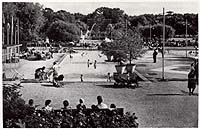
First Postcard of Battersea Park, 1970
162 x 250 pixels, 23 Kb
292 x 450 pixels, 50 Kb
486 x 750 pixels, 100 Kb
648 x 1000 pixels, 178 Kb


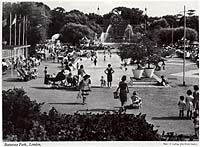
Second Postcard of Battersea Park, 1970
184 x 250 pixels, 25 Kb
330 x 450 pixels, 52 Kb
551 x 750 pixels, 103 Kb
734 x 1000 pixels, 167 Kb


| Title |
|
| Benches | << |
| Benches: Unabridged | |
| The Flower Before the Bench | |
| Postcard Sources | |
| After Benches: Tapestry | |
| Come & Go | |
| Homage |

This picture began its existence with a chance meeting between myself and a postcard on Euston Station at 8.05 a.m. on Tuesday 17th February 1970. Most of the many postcard purchases that I have made have the feeling of Ezra Pound's category, 'not source material but relevant'. This one however spoke to me directly of mortality. Stark light fused the group while better delineating its members in their isolation and separateness. They were the assembled cast of a tragedy and or its spectators: the ironic brightness of council flowers and the drab gaiety of the surrounding concrete parkland reinforced these impressions.
My destination that same day was Wolverhampton College of Art. Upon reaching it I found that the office staff had collected together all the postcards they had sent each other while on their several holidays the previous summer; cards from Lugano, Cleethorpes, Salzburg, the Isle of Wight etc. Their random selection of (mostly peopled) summer scenes, did seem to offer corroboration. Because there were so many unifying factors (provenance, purpose, sunshine, unfactitiousness of choice etc.) another such factor could, by poetic extension, be postulated; that the source photographs for these postcards were all taken in the various places at the same instant as the postcards of Battersea Park. Thus the comic-strip writer's use of the link-word 'meanwhile' could be adopted to connect this with other images.
The unifying motif of benches (as the stationary vehicles of mortality) emerged over the next months especially after a fruitful visit to Bournemouth and the receipt of a spectacular card of Harrogate from Richard Morphet. For a long time the painting occupied two canvases only and it was the chance discovery of yet another postcard of the scene in Battersea Park which showed the same bench in what was evidently a different (and later?) year, that made possible the symmetry (both physical and iconographic) of this hitherto one-winged bird. > >




tomphillips.co.uk > > Paintings and Drawings