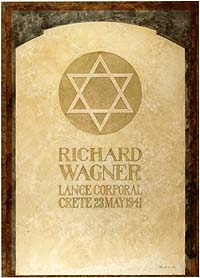
Design for Richard Wagner
XXX on XXX, XX cm, 1988
555 x 400 pixels, 45 Kb
847 x 610 pixels, 90 Kb
1069 x 770 pixels, 134 Kb
1388 x 1000 pixels, 146 Kb


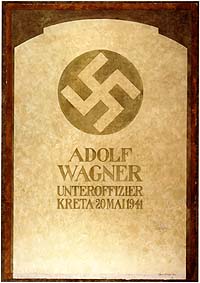
Design for Adolf Wagner
XXX on XXX, XX cm, 1988
566 x 400 pixels, 47 Kb
864 x 610 pixels, 95 Kb
1090 x 770 pixels, 141 Kb
1416 x 1000 pixels, 155 Kb


I decided to make a double-sided tombstone for the two Wagners, who had now become inextricably linked in my mind. The stone would have features both common and unique to each of the originals. Since the German stone had no emblem I would parallel the Star of David with (as surely would have been the case had Germany won the war) that potent sign (which served as a benign device in cultures such as the Akan and Hindu) the now disgraced and unrehabilitable Swastika. As Adolf Wagner had his first name on his stone so would Richard, and so on.
On a second visit to Crete I made measurements and rubbings and took photographs so that nothing of the work would fail to reflect features of the originals and that the width, height, and thickness of my own sculpture would embody all their proportions.
On my return I told Angela Weight of my idea and was cheered by her enthusiasm. I also spoke to Jewish friends to reassure myself that my own certainty was no misplaced and that my intentions would be clear enough not to cause misunderstanding or offence.
Andy Gizuakas suggest that the local firm of Taylor Pearce would be the right people to undertake the carving: I was happy to thing that the work, which had bee conceived in South East London, would both be fabricated and finally shown there. Everything seemed to fall into place when I met Graziella Ainsworth who was to carve the inscription since she in herself, being half Argentinian and half British, embodied the only other war my work (however fleetingly) has documented. A fine stone was ordered and Graziella made an excellently sympathetic job of carving from my drawings.
Excited by the prospect now, after two years, of an unveiling on Crete Day (20th May) 1988, I went with Angela Weight to the grounds of the museum to find a suitable site where the light would strike each side of the stone more or less equally. We found and tried out an ideal spot in a part of the front lawn that had all the characteristics of a graveyard. Jake Auerback who had filmed the carving was ready to document whatever ceremony might take place.
I asked John Craxton to send me some Cretan earth both to rub into the surfaces (to simulate the roseate look of the graves at Suda Bay which were splattered with earth whenever the flower beds were sprayed) and to mix with English earth and German earth at the foot of the stone when it was eventually placed in the ground.
It is I suppose not unusual for an artist in his vanity to forget, while in the euphoric state caused by having found what he thinks exactly the right, elegant and morally appropriate solution to a problem, that these convictions are not likely to be shared by everyone who sees the result. The piece was duly delivered to the Imperial War Museum whose trustees thought little of it, accepting it only with reluctance. No fanfares, no unveiling. Through some failure of nerve the plan of siting it in the museum grounds was abandoned. Almost a year later the stone still lies, unexhibited except for a brief showing inside the museum, in the basement store. It will never weather as intended and I am left with the now irrelevant packet of earth; a handful of dust.
Work and Texts (1992), pp. 111-15.