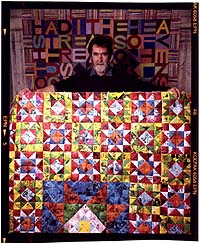
Tom Phillips with Women's Work, 1997
487 x 400 pixels, 84 Kb
743 x 610 pixels, 147 Kb
938 x 770 pixels, 198 Kb
1186 x 974 pixels, 259 Kb



Every phonebox from Mayfair to Pimlico and from Paddington to Kings Cross is festooned with vivid cards advertising prostitutes. Stridently competitive in colours and image they are a phenomenon of the eighties and nineties and are virtually unique to London. They would not be there if what my mother used to call 'ladies of the night' (although some are gentlemen and others offer a twenty four hour service) were allowed, as in other European capitals, to advertise in the Yellow Pages.
As a result therefore, of a typically British act of backfiring censorship a busy folk art has arisen with its own chapbook-like style of design and typography and its own verbal code ('Greek', 'TV', 'water-sports', etc.). Although there are now glossy variants of multicoloured sophistication, the generic single colour card with black artwork, hastily produced, is still the finest and most common kind. These I have used both in Women's Work and Manpower.
At the opposite end of the spectrum of female occupations is the making of quilts which has undergone a revival in recent years, especially in America where the quilting bee is no longer the sole province of the women's institute or groups of folksy matrons. In British history there is a connection between sewing and prostitution. In the Victorian era the seamstress augmented her earnings by such means and the prostitute gained a little extra money between clients by taking in sewing. This is in contrast to the clear opposition in the male imagination of the 'little woman' at home plying her patient needle and the potent object of erotic desire offering outlandish sexual adventures. > >


tomphillips.co.uk > > Sculpture & Mixed Media