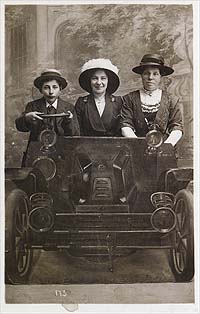
We Are the People: Automobile
Selected by Tom Phillips, 2004


In early March 2004, the National Portrait Gallery opened an exhibition that has become an unexpected sensation, "We Are the People: Postcards from the Collection of Tom Phillips RA."
The show comprises more than one thousand photographic postcards from the first half of the twentieth century, selected by Phillips with an eye toward expressions, postures, composition, and settings that rise above commonplace studio photography, and remain in the viewer's memory.
Phillips himself writes, "These photo postcards are historic in the sense that this was the first time people stepped into the light and were seen as individuals rather than the unpictured masses of previous centuries. I wanted to make an alternative National Portrait Gallery collection featuring the rest of the nation - those who did the work, bore the children, fought the wars; the previously unknown and unsung."
The following essays further illuminate the exhibition, and are accompanied by some of the included images.
- My Father the Boxer, by Tom Phillips
"A constant theme of the cards in the exhibition is modernity: though they come from the past they urgently depict their present and carry it forward into our future."
- Return to Sender, by Matthew Sweet
"The result was a democratisation of photography: thousands of ordinary people sitting in front of a camera for the first time in their lives. A nation saying 'cheese' together."
- The Charm of the Ordinary, by Kevin Jackson
"Not since the Mass-Observation retrospective of the early Nineties has there been a major photographic show in which the comments in the visitors' book have been as significant a component of the gallery experience as they are for the NPG's We Are the People."
- WAtP: Multimedia Presentation
A Flash animation melding the RA Summer 2002 audio commentary with the images from the show.
- First view: RA Summer Exhibition 2002
Audio commentary (mp3 format) by Phillips describing the process and motivations behind We Are the People.
tomphillips.co.uk > > Sculpture and Mixed Media