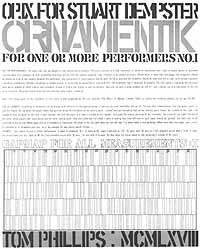
Ornamentik
Opus 9, screenprint, 1969

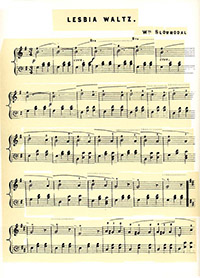
Lesbia Waltz, p. 1
Opus 15, screenprint, 1972

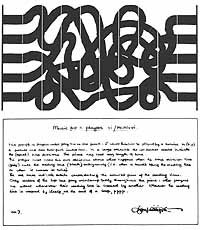
Music for n Players
Opus 2, screenprint, 1966

|
Click here for a BBC4 interview exerpt [mp3] about Tom's involvement with the new music movement of the 1960's, as well as his and Brian Eno's invention of "piano tennis." |

As A Humument could be said to be the poetry of a non-poet so the pieces of music that I have written could be called the compositions of a non-composer.
My credentials as a musician are motley and insecure: they consist mainly of failed flirtations with various instruments at school (a dismal affair with the violin and some years behind the bassoon in the school orchestra). Later I bought myself a piano for thirty shillings and taught myself to play it, at least to the point where I could improvise freely and release to the living-room all the pseudo-music I had been storing up. In the fifties I joined the Philharmonia Chorus as a founding member and had the thrill (without having to take much of the responsibility) of performing under Klemperer, Hindemith, Beecham, Stokowski, Karajan etc.
When Cornelius Cardew founded the Scratch Orchestra (whose loose constitution was drafted in my garden) I joined in most of the concerts in its musical phase (before dreary Marxism was succeeded by even drearier Maoism) and contributed to its anthologies. Taking part in large scale performances of Cage (Atlas Eclipticalis) and Cardew (The Great Digest and Schooltime Compositions) was a formative and emancipatory experience. It is easy to forget what joy there was in those pre-factional days in such events as the Scratch Orchestra's Beethoven concert at the Purcell Room (in the 'Popular Classics' series).
It was however in the mid sixties that I first started to write compositions of my own. These came out of an association with the pianist John Tilbury and from my first wife's involvement with music for children. Other enlightening influences were meetings and familiarity with the music of Morton Feldman and Christian Wolff. In the seventies I met the French composer Jean-Yves Bosseur and have collaborated with him in compositions, performances and recordings.
The fifteen works that I published and listed in Works/Texts to 1974 were all written between 1962 and 1972. Until 1991 it looked as if they would represent my entire output. They were very much of their time, and little played: in some cases their first performances were probably also their last. These were often given by myself and John Tilbury at art schools in those far off liberal days in ghastly places (oh Walthamstow! oh Watford! oh Wolverhampton!) when students in colleges of art could spend time exploring the relationship of sound to graphic expression. This perhaps accounts for the theoretical nature of some of the scores where the notation drifts toward visual elegance at some expense to musical practicality.
As always there are exceptions and it is the last written of all these, Lesbia Waltz, where the balance is almost successfully resolved. It is a pure example of a structuralist critique applied to a piece of music. While not (yet) quite an evergreen Albumblatt it has been frequently performed, in the early nineties (in a very eccentric 'normalised' and romantic rendering) by Barry Douglas in Belfast, and in June 2001 by the Ensemble Modern at Berlin's Konzerthaus. The Composers Ensemble under John Woolrich have prepared a version for chamber group. The title Lesbia Waltz is no more my own than the notes are (although the displacement of the key change delivers some into my charge). Those who have ploughed through Smallwood's Piano Tutor will recognise the piece as the culmination of that course. Like the newly named composer (Slowmodal) the waltz is an anagram of its original. Every repeated or recapitulated bar is shifted to the point of its first appearance so that my Opus 15 is, so to speak, Lesbia Waltz ordered and arranged as if by a filing clerk.
Of the others (excluding IRMA) Ornamentik has proved the most durable. Although at its first performance in the Cheltenham Festival (1969) it was described by the critic of the Daily Telegraph as providing him with 'the most boring fifteen minutes of my life' (little did he know what the eighties would bring his way) I find it as tense to play in as it hopes to be soothing to hear.
The ballet Grenville, and its companion-piece People on Postcards, remain as hypothetical as when they were boastfully announces as 'work in progress' in Works/Texts to 1974. > >
Works/Texts (1992) p. 272-276.


tomphillips.co.uk > > Paintings and Drawings