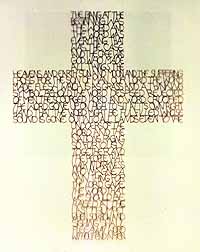
Word Cross
Wire, 230 x 182 cm, 1997

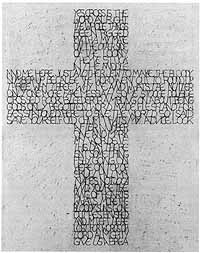
Joca (Study for Golgotha)
Pencil on paper, 67 x 50 cm, 1996-1997

Word Cross 1997
The classical mystery of the Bible is its own first assertion that the Word was the beginning of all that was made. Thinking about this led to the theme of the cross, since Christ was the Word made flesh. Thus the subject of numerous collages made at the beginning of the nineties (e.g. Brent Cross) here merges with later works. The first cross exists independently and was exhibited at the 1997 Royal Academy Summer Exhibition. This is the cross of Christ and speaks of the embodiment of the word in the Old and New Testament in a delirious stream of dying consciousness. The idea of the speaking cross is no novelty since it first appears in an Anglo-Saxon poem, The Dream of the Rood a thousand years ago.
Golgotha 1997
Two flanking crosses make up the triptych of the crucifixion. These represent of course the two thieves who were crucified with Jesus. In apocryphal writings the appearance of the thieves in the story is planted back in Christ's infancy. The Venerable Bede names them as Matha (the good thief) and Joca (the bad thief). They were two of a band of robbers who came across the Holy Family in their flight from Egypt. Matha, sensing the special nature of the child, warns the others off. The infant Christ tells them that they are all three destined to die together. Thus the triple deaths at Golgotha (which means 'the place of the skull') represent another fulfillment of the Word.
Each of the thieves' crosses talks of this incident and what is taking place now and each end with a Kyrie Eleison, Joca's being a rough version ('Lord, give us a break') which is cut short by his death. Although Joca superficially scorns the idea of Christ's divinity, his redemption is indicated (as is Matha's) by a line moving right through the cross inclined toward Jesus.
Sacred and Profane / Drawing to a Conclusion (1997), p. 12-17.


tomphillips.co.uk > > Sculpture and Mixed Media