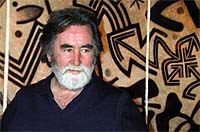
Tom in Fort Worth with Rima's Wall
Photographs by John Nick Pull, 2001

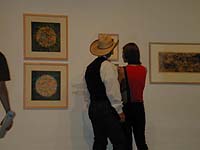
Works: Music World I & II; Single Stave Collage

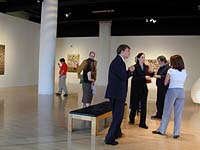
Works: Rima's Wall; Heldentenor;
Last Notes for Iris

| Title |
|
| Intro by Tom Phillips | << |
| Bio by Bill Hurrell | |
| Gallery | |
| As You Enter | |
| To Your Right | |
| To Your Left | |
| At the Windows | |
| Behind You |
Strange how long it takes to spot one's own habits. For almost forty years now, whenever I have private thoughts to unravel or have needed to break free, I have turned on drawing in charcoal and pastel; often on a large scale.
A recurrent theme of these drawings has been my relationship to music. Listening, performing and (occasionally) composing it has played a huge part in my emotional and intellectual life.
It was a happy honour to be invited to follow in the footsteps of distinguished fellow artists Sean Scully and Robert Rauschenberg in designing the motifs for the current Van Cliburn Festival. Out of that arose the idea of a show of that aspect of my artistic output that most relates to music. My love of it inhabits haunts and occasions most of the works in this exhibition.
Some are almost direct transcriptions of imagined musical events, conjuring up compositions on a scale beyond my technical equipment as a composer. Concerto Grosso came directly out of hearing a piece by Schnittke in London earlier this year. Last Notes for Iris has a sadder agenda in that it derives from the idea of the disintegration of a sound world. I was thinking of the final years of my friend Iris Murdoch the novelist and music lover who, as a sufferer from Alzheimer's, was condemned gradually to say farewell to its consolations.
Erde, Loge and Feuermusik (Fire Music) refer to Wagner's Ring of the Niebelungen and Spring Song evokes Mendelssohn's visits to my own London neighbourhood (it was originally called Camberwell Green but Mendelssohn's publishers thought that a poor title for the hit they had on their hands). Most of the musical allusions are explicit in the titles. The largest work in the show, Rima's Wall, has a literary source in HWK Collam's Unhaunted Comma (the first part of Come Autumn Hand) and relates to music via dance and the rhythmic structure as described by that novelist.
Music is a language with its own signs and devices. I have always been enchanted by the look of its notation, how the staves and dots encode and trap the magic. Wittgenstein's Dilemma (The limits of my language are the limits of my world) is put to the test.
All for me is summed up in the smallest of all the exhibits (a fragment of my book A Humument) which describes the existential situation in a few words. "The Sound in my Life enlarges my Prison." It reminds me of many enriching conversations I had with Morton Feldman, the great American composer who loved painting and (as if providing the mirror image of this show) made music to echo the processes of painting. > >
Exhibition Notes, Fort Worth 2001


tomphillips.co.uk > > Essays and Exhibitions