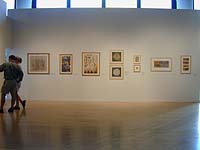
Drawing on Music: To Your Left
Photographs by John Nick Pull, 2001

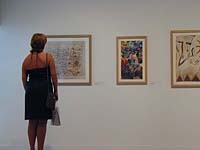
Feuermusik (der Ring), Gershwin,
and Camberwell Green

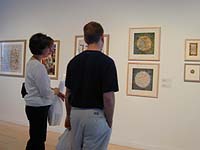
At right: Music World I and II,
Small Music Collage from Plato's Syposium,and The Sound in My Life

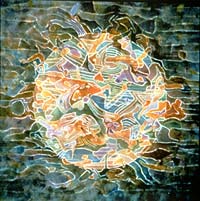
Music World I
Watercolour on paper, 36.8 x 36.7 cm, 1999

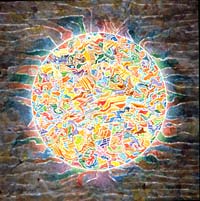
Music World II
Watercolour on paper, 36.8 x 36.7 cm, 1999

A closer look at Stave Collages

| Title |
|
| Intro by Tom Phillips | |
| Bio by Bill Hurrell | |
| Gallery | |
| As You Enter | |
| To Your Right | |
| To Your Left | << |
| At the Windows | |
| Behind You |

Feuermusik (der Ring)
Pastel on paper, 72 x 66 cm, 1992.
Gershwin
Pastel on paper, 79 x 51 cm, 2001.
Camberwell Green (Spring Song)
Pastel on paper, 83 x 62 cm, 1979.
Music World I
Watercolour on paper, 36.8 x 36.7 cm, 1999.
Music World II
Watercolour on paper, 36.8 x 36.7 cm, 1999.
Small Music Collage from Plato's Symposium
Collage on paper, 34 x 27 cm, 1991.
The Sound in My Life
Pen, ink, and watercolour on book page, 28 x 26 cm, [n.d.]
Single Stave Collage
Collage on paper, 54 x 86 cm, 1993.
Multiple Stave Collage
Collage on paper, 73 x 42 cm, 1992-93.
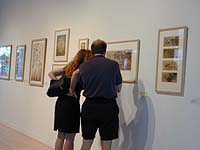
The wall to your left offers the densest arrangement of pieces in the exhibition. There are as many on this wall as in the rest of the exhibition combined.
They comprise works in pastel, watercolour, and collage, and span more than twenty years; from 1979's Camberwell Green (Spring Song) to Gershwin, completed shortly before this exhibition.
As with most other pieces in this show, all relate to music. The eldest takes its title from a popular work by Mendelssohn:
The Camberwell/Peckham axis is no Johnny Come Lately to the world of culture. On his visits to London Mendelssohn would stay with one of his Jewish banker friends near what is now called Ruskin Park (in honour of another denizen). It was there he wrote this famous melody and named it Camberwell Green. His publishers however wisely advised him that Spring Song would be a more sellable title. They were right. My drawing celebrates with regret the loss of a local association but allies itself with the sense of Spring's uplift the piece evokes. Only weeks after finishing the drawing an ice cream van came from the direction of Camberwell Green past my studio and its chime played a somewhat speeded up version of Spring Song. It could not be of course that the vendor in this van knew the connection but my racing mind urged on by the accelerated tune furnished an alternative solution. Italian ice cream vendors have been in the area as long as Jewish bankers and composers: what if this particular merchant had had the melody in his family for generations as a song to sing or tune to whistle as they went their rounds. Perhaps, I thought, even before Mendelssohn ever set foot in Camberwell...At the far left of this wall is Feuermusik (der Ring) a drawing that, with two from the wall behind you (Erde and Loge), take their inspiration from Wagner's Ring of the Niebelungen. More about those on the BEHIND YOU page.
Next is the newcomer whose centenary was celebrated not-so-long-ago. Gershwin was a popular favorite during opening weekend here in Fort Worth; we'll be posting a clearer photo of it as one becomes available. The artist writes:
Gershwin started life in 1999 as a much larger drawing which included the whole of a grand piano and a haunted singer plus ghostly audience. After about a year when the drawing got only occasional attention I suddenly realised that the pianist was the real subject and that his mood when isolated reminded me both of Gershwin (himself an accomplished painter) and his music. I separated out this segment and worked on it anew to reinforce that identification and finished it in 2001.At the center of this arrangement are the two watercolours commissioned for the Eleventh Van Cliburn International Piano Competition: Music World I and Music World II. The artist writes:
Coming from the ancient notion of 'The Music of the Spheres,' these two images are meant to suggest worlds which are alive with potential music, with pre-echoes of scores, rhythm, and harmonic event.
Next, the collage works on this wall represent a much larger, decades-long exploration of the medium. The artist has used collage to explore musical notation (as seen in this exhibition), lives of composers, and the iconography of Western religion. The collage from Plato's Symposium is one of six created from an edition published by The Folio Society. To see it among the other illustrations, click here (the one from this exhibition is the third in the group).
For a full tour of the artist's collage works, please click here.
The last of the group contains the refrain that seems to sing throughout the exhibition: The Sound in My Life Enlarges My Prison. This small ink and watercolour on a printed page comes from another lifelong project, A Humument. The for more than thirty years the artist has collected copies of a specific printing (London, "New Edition", 1892) of a specific title (W.H. Mallock's "A Human Document"). Every page in the book has become a canvas for him. Various media cover the pages (paint, ink, collage), top to bottom but for a handful of words, untreated, that rise to the surface like half-translated axioms from a long-drowned Atlantis.
For page images of the first printed edition of A Humument click here. For essays and general information about A Humument, click here.
To the right of this gallery wall, sunlight is streaming in through plate glass. Two sculptures are there, IN THE WINDOW. > >
Web-Only Exhibition Notes, Fort Worth 2001


tomphillips.co.uk > > Essays and Exhibitions