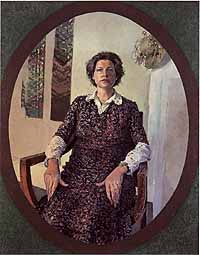
Shirley Cargill
Oil on canvas, 76 x 61 cm, 1976-77
510 x 400 pixels, 43 Kb
777 x 610 pixels, 87 Kb
981 x 770 pixels, 121 Kb
1274 x 1000 pixels, 181 Kb


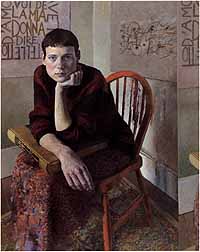
Pella Erskine-Tulloch: The Dante Binding
Oil on canvas, 78.7 x 63.5 cm, 1981-82
505 x 400 pixels, 33 Kb
770 x 610 pixels, 61 Kb
971 x 770 pixels, 88 Kb
1261 x 1000 pixels, 134 Kb



I don't quite know how it has happened by suddenly in the nineteen eighties I begin to find myself a portrait painter. Perhaps it would be more accurate to say that I've 'come out' as a painter of portraits since, for as long as I can remember, I have consistently made drawings of friends and occasionally painted pictures of them. Bit by bit this activity has moved from the margins to near the centre of my practise and a body of work has built up sufficient to make an exhibition in itself, although painting people from life still occupies on average only half the mornings of the working week (the afternoon light in my present studio being unsuitable).
My growing concentration on the activity really dates from the companion portraits commissioned by David and Shirley Cargill in 1976. These led me on to painting my mother as a way of spending more time with her. I remember first drawing her when I was about twelve, though I probably did one of those big moon faces at infant school with MUM written underneath: therefore (since I was painting her only yesterday) she has been after almost half a century my longest serving portrait model. Then came infatuation with a particular face, which I suppose has been the cause of so many of the portraits in museums throughout the world. Over a period of about ten years I must have made almost a hundred images of Pella Erskine-Tulloch.
Painters are jealous of time, yet, like everyone else they want to see and talk to their friends. I usually like to have sporadic conversation during sittings since it helps to keep the faces of subjects from lapsing into blankness. I like also to learn more about them since this feeds the work: it is better anyway if they talk rather than I, for, while painting I am on automatic pilot as a conversationalist. These exchanges also assert the difference between a sitter and a model.
Portrait painting gives long and sustained intimacy especially if the artist is, like me, a slow worker who needs many sittings. Almost always I regret coming to the end of the work since that means that the sitter and I will no longer be so much part of each other's biography and hear of each other's lives the blow-by-blow story. As from some therapy there are withdrawal symptoms on the other side as well. Not everyone of course is willing to come twenty times to an untidy room in Peckham for what after all is quite hard work, yet those who do invariably tell me that they enjoy the experience. Busy people especially find it makes a wonderful alibi for two hours of comparative idleness.
When making portraits I have no procedures to lean on nor worked out plans of attack. The nearest thing I have to a strategy is my own incompetence. The inability to get anything 'right first time' (or even second or third time) allows me a greater opportunity to explore the personality of te sitters and the moods they establish: more expressions pass through their faces and through the picture. Weariness relaxes posture into a naturalness that is difficult to achieve in an alert state. No artificial pose or manner can be sustained by a sitter through months of painting, as it can for the camera' instant, nor can any shield of vanity be held up that long. The final image is an amalgam of many moments and states of mind: the right eyebrow might be resolved on a happy Thursday and the left on some succeeding Monday of gloom.
All I can do is to make a contract with my sitters that they should turn up as regularly as their life allows, wearing approximately the same things, and that I should paint them as best I can. I rely on the conjunction of the two selves to throw up ideas for the work as it goes along. It is a collaboration.
I usually start by making one or two studies so that I can get used to the presence of the sitter in my studio and so that he or she can get used to the (in)activity. I try to learn their faces.
Once I get to work on the canvas itself I find it a nerve racking endeavour. I fear to waste the sitter's time as I dither, frittering away the hours it seems in indecisive manoeuvres. It is immensely frustrating to work for session after session without seeming to make any progress, but somehow (and in the final analysis I do not know why or how) some presence seems to emerge, a statement real enough to argue with. Getting a likeness is not the problem: any professional should be able to achieve that in a couple of sessions. The problem seems to be in reconciling a set of possible likenesses into a unity that has the feel of the subject's actually being there. The great test, as HWK Collam says, is to turn the picture to the wall and see if it seems that someone has suddenly left the room. Once, so to speak, this lack of absence is caught many problems fall away, new elements suggest themselves to occupy the space that reality has created: painting a person has turned into painting a picture.
There are enormous consolations in portrait painting apart from the vicarious experience of specialised lives, learning how a restaurant or an opera house is run, etc. I like the fact that portraits are rarely objects in commerce and especially that their first home is usually where they will stay: they will seldom come up in the salerooms where pictures of mine, if I chance upon them, look forlorn and unloved. The sitter has made a commitment far larger than mere expenditure of money and is not usually going to part with something in which he has invested his own self.
Portraiture, I grow more and more to feel, is a very special category of painting and a very particular act of art: it involves two people in a room one of whom is trying to be painted by the other.
tomphillips.co.uk > > Portraits